
https://raw.githubusercontent.com/OrcVole/pijul-cloudron/main/CloudronVersions.json
Description
352
The Nest is the hosting platform for Pijul, a distributed version control system built on a sound theory of patches rather than on snapshots and three-way merges.
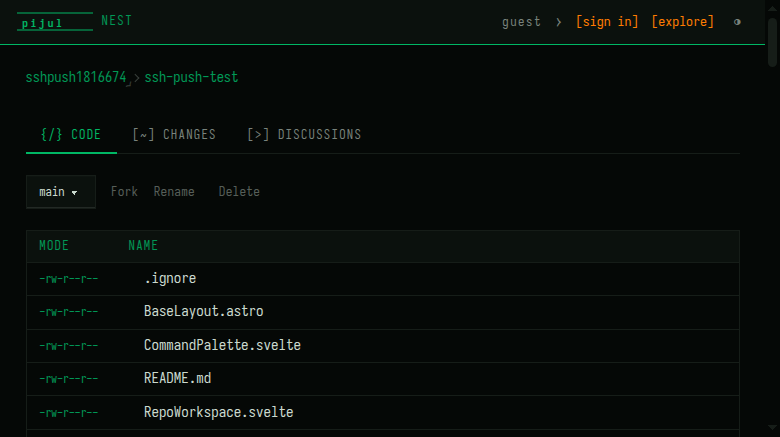
It gives a Pijul repository the things a repository needs once more than one person touches it: user accounts, a web interface for browsing changes and file trees, discussions attached to a repository, cloning over HTTPS, and push over SSH.
Why Pijul rather than Git
Pijul's model is commutative. Two changes that do not touch the same lines can be applied in either order and produce the same repository, which means a change can be pulled from one branch into another without rebasing, cherry-picking, or the merge conflicts those produce. Conflicts still happen when two people genuinely edit the same thing, but they are represented in the repository rather than resolved and forgotten, so a resolution can be revisited.
If you have wanted Darcs' theory with performance that does not fall over on a large repository, this is that.
What this package gives you
- The web interface, at your own domain
- Repository hosting with per-user accounts, public and private repositories
- Cloning over HTTPS, working immediately with no port configuration
- Pushing over SSH, on a port you choose at install time — the Nest's HTTPS surface is clone/read only; pushing a change requires SSH
- Discussions and change review
- Outgoing email through the Cloudron mail relay, for password recovery and notifications
What is deliberately turned off
The Nest is the software that runs Pijul's own hosted service, so it carries features that only make sense there. This package disables them:
- Billing. No Stripe keys, no paid tier, no pricing page.
- CI. The job runner is not configured, and no CI endpoints are registered.
- Zulip notifications.
Private repository and storage quotas, which default to zero on the hosted service, are raised to values that make sense for a self-hosted instance.
Accounts
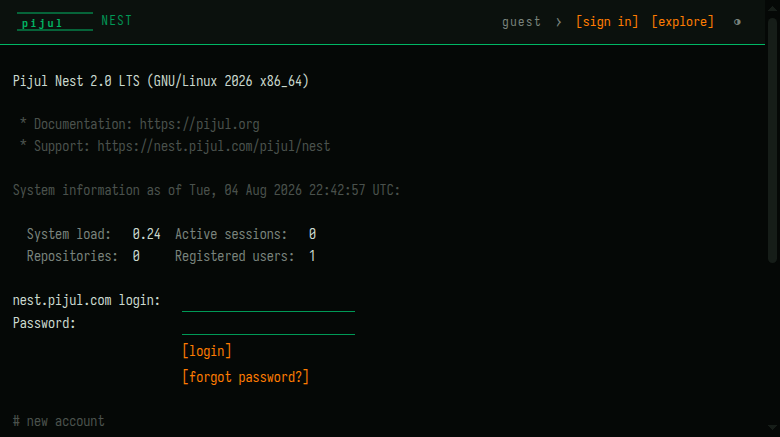
The Nest has its own account system with its own password handling. It does not support Cloudron single sign-on: there is no OIDC or LDAP support upstream to map onto. Users register on the instance itself. The first account you create is yours to administer with.
Cloudron's proxyAuth is deliberately not used. It would gate the whole HTTP surface, which for a
version control system means breaking every push and pull.
Status
Pijul and the Nest are pre-release software. Upstream does not tag releases, so this package pins an exact upstream change and records it in the changelog. The version number belongs to the package, not to the Nest.
Recent Changes
Upstream pijul-nest 334 to 352 (seventeen changes, 2026-10-14 to 2026-11-13). Pinned to change
F6ZXR73AIXVRTZHHR4JOAB2FFA42UTYB7JYWPIXCRDHHIT5PFRKAC, state MGIZXVUEKTLG2KQSATVRFRUNTWF2DXKHM67AJIIUJZR7LLOBLOTAC
(2026-11-13). Upstream has no release notes; this is written from the change messages.
Discussions: the list shows newest first with closed ones included, pages with Newer and Older buttons,
and marks each row open or closed. Discussion and change pages list the files each patch touches. Discussion
pages now update live when a discussion is closed, a patch lands or a comment arrives; before, the browser
waited on the page's own refresh.
Review: comment text keeps its formatting (lists, quotes, code, tables), comments can be stepped through
from a floating navigator and linked to directly, and reviews appear in the discussion timeline.
Pushing: a push with
--to-channel source:targetopens its discussion on the source channel, pushing to anew discussion is only refused when an open discussion has the same title, and a read-only
<channel>+openview lets a client skip patches already under review.CI: a new job now stops older unfinished jobs on the same channel, and a job is no longer shown as failed
when its stream is merely slow. CI stays disabled in this package.
No database migrations and no new settings: nothing to do on upgrade.
Under the hood: the Nest now builds against pijul-core 1.0.0-beta.27 and a newer HTTP client with a
different TLS stack.