
https://raw.githubusercontent.com/OrcVole/openbao-cloudron/main/CloudronVersions.json
Description
2.7.3
OpenBao is an open source identity-based secrets and encryption management system, a community-driven fork of HashiCorp Vault stewarded by the Linux Foundation under the OpenSSF. It provides a central, audited place to store, generate and control access to secrets: API keys, passwords, certificates and encryption keys, with a web UI, a CLI and a Vault-compatible HTTP API.
This package is built for unattended operation on Cloudron:
- Auto-unseal by default. The package configures OpenBao's built-in static key seal, so the instance comes back serving secrets after every restart and automatic update with no human intervention. (Self-hosted Vault and OpenBao installations normally require an operator to paste unseal key shares after every restart.)
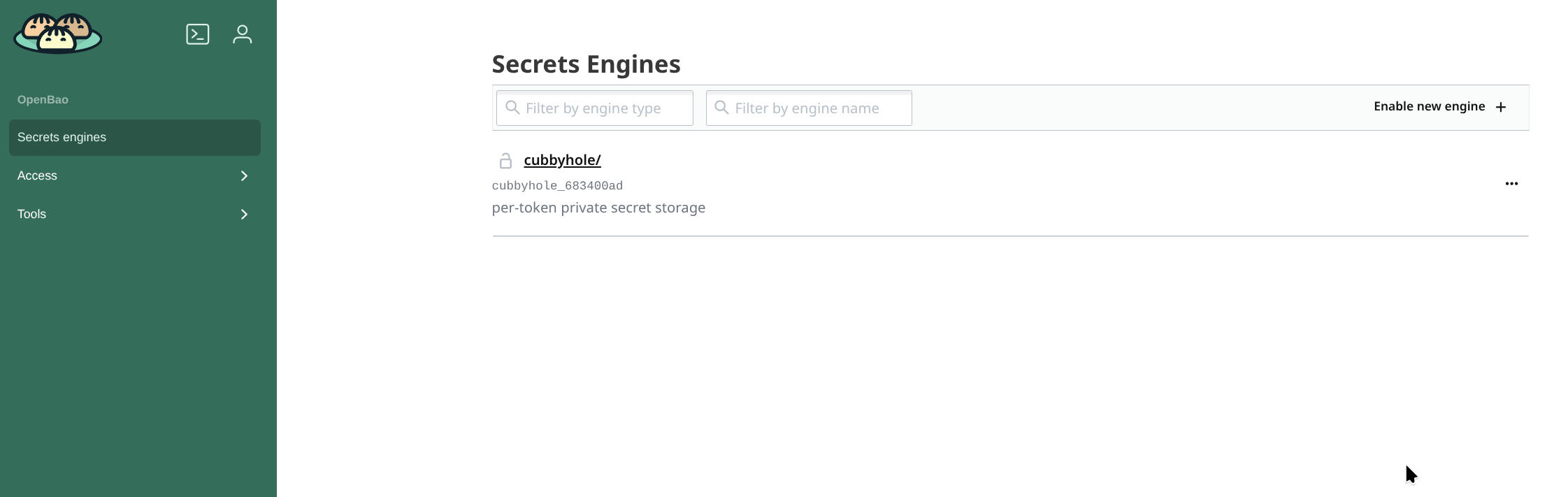
- Initialised out of the box. On first start the package initialises
OpenBao, enables the KV v2 secrets engine and a file audit device, and leaves
the root token and recovery keys for you in
/app/data/.secrets. - Consistent backups. Integrated raft storage is snapshotted hourly with OpenBao's own snapshot mechanism, and the snapshots ride Cloudron backups. Restores and clones rebuild the store from the newest snapshot automatically.
- Honest health reporting. A sealed instance reports unhealthy to Cloudron instead of pretending all is well.
- Cloudron sign-on and app integration. Cloudron accounts can log in to the UI via OIDC (with no access to secrets until granted), and other apps consume the Vault-compatible API with AppRole credentials.
The convenience of auto-unseal has a stated cost: the unseal key lives on the same server as the data it protects. Read the post-install notes for the threat model and the hardening steps (off-server copies of the recovery material and encrypted Cloudron backups). A manual-unseal (Shamir) mode is available for operators who prefer it.
This is an unofficial community package. It is not affiliated with or endorsed by the OpenBao project, the Linux Foundation, or Cloudron. OpenBao is distributed unmodified under the Mozilla Public License 2.0; source code is at https://github.com/openbao/openbao.
Recent Changes
OpenBao 2.7.2 to 2.7.3, a security release (all in upstream PR #4550).
Action may be needed (GHSA-fgmw-h9wp-wc7g). 2.7.3 adds a per-mount setting,
case_sensitive_alias, for authmethods whose user or group names differ by letter case. It is off by default, for existing and for new mounts.
Upstream's release note says new mounts are case-sensitive by default; on 2.7.3 they are not, and upstream's own
command help says the default changes in 2.8.0. To turn it on for a mount:
bao auth tune -case-sensitive-alias=true <path>/. Check first how your identity provider treats letter case.For requests forwarded from a standby node, client certificate headers, the disabled unauthenticated rekey and
root-generation endpoints, and the request size and duration limits are enforced again (GHSA-h8fh-pmch-cjww). This
package runs a single node.
Bug fixes include raft snapshot save and restore through a redirect, lease revocation in child namespaces,
single-use control group wrapping tokens and
max_versionsprecedence in KV. The bundled plugins are unchanged.