
https://raw.githubusercontent.com/OrcVole/crawl4ai-cloudron/main/CloudronVersions.json
Description
0.9.6
Crawl4AI
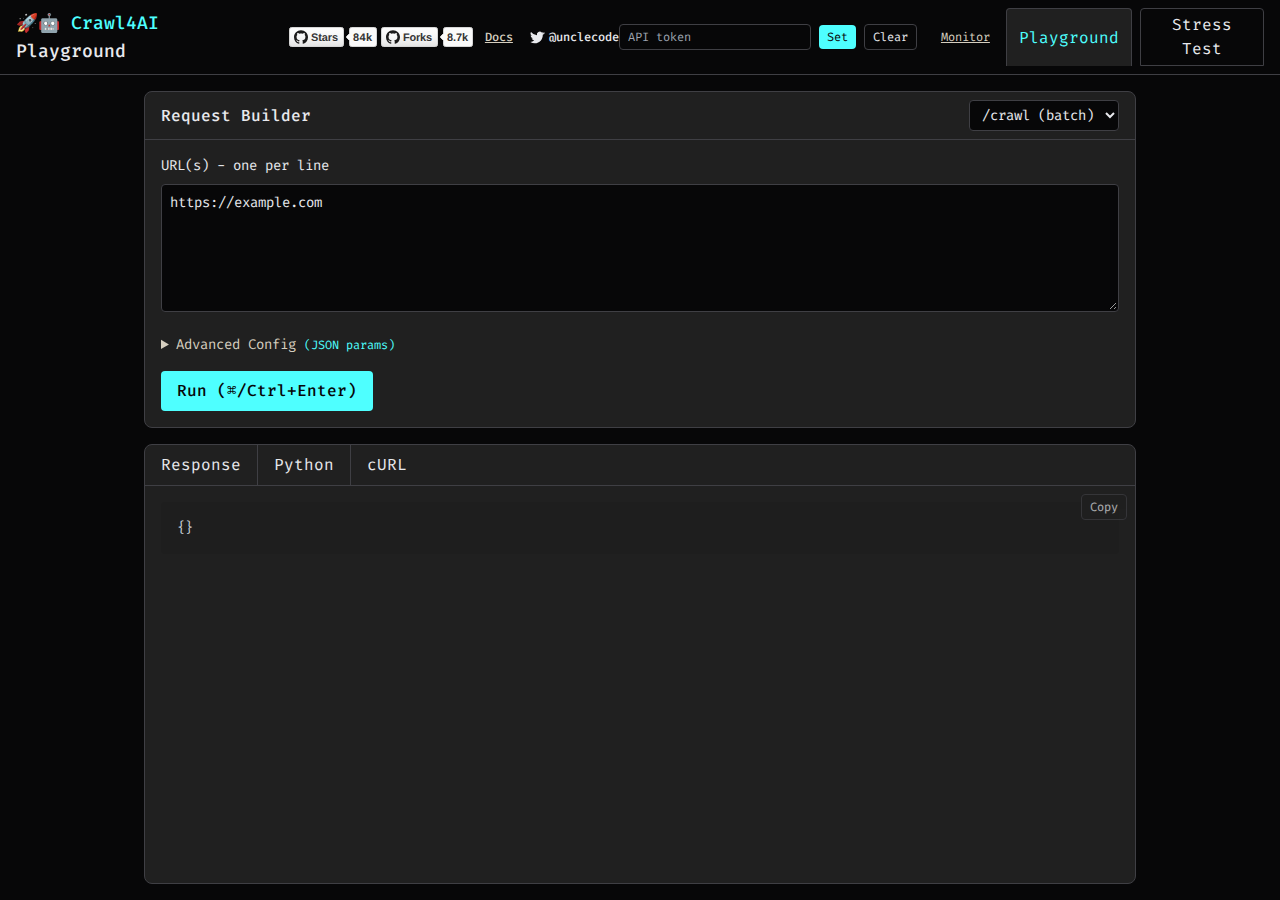
Crawl4AI is an open-source web crawling and extraction API, built to feed clean data into language models or automation workflows. It fetches a page with a real Chromium headless browser and returns the content as clean Markdown, raw HTML, a screenshot, or a PDF. The package exposes both a REST API and an MCP endpoint, so AI agent tools can call it directly.
Every request requires an API token, generated automatically the first time the app starts. There is no way to use the service without it. Because the browser runs inside a container, its own security sandbox cannot be enabled; this is the same situation every headless-browser app on Cloudron is in (browserless included). The package compensates: the token is required on every call, requests to addresses inside your server's own private network are refused by default, and optional scripting hooks are disabled.
Nothing here needs backing up beyond the API token itself: there is no separate database, and crawl results are not kept.
This package includes software developed by UncleCode as part of the Crawl4AI project, licensed Apache-2.0 with an attribution requirement (see NOTICE). It is a community package, not affiliated with or officially supported by the Crawl4AI project.
Recent Changes
Update Crawl4AI to 0.9.6, a security release that upstream says closes eleven coordinated-disclosure
advisories: GHSA-qwxw-87g2-26vm (SSRF through URL userinfo in the TLS certificate fetch),
GHSA-9xxj-3r64-qw54 (browser context shared between API callers), GHSA-8696-2734-9jqw (ReDoS gate bypass),
GHSA-phmg-6873-j3gj (vulnerable Brotli decoder, CVE-2026-111497), GHSA-jfhw-vrxg-wpcw (memory exhaustion
through markdown options), GHSA-8x85-mx8f-wj4v (unbounded sitemap index following, library only),
GHSA-x4gh-gvcx-p9gp (declarative hooks kept on the pooled crawler), GHSA-3q59-v69g-m9vc (request size
limit skipped chunked bodies), GHSA-363x-fqh9-cvp2 (TLS certificate fetch blocked the event loop),
GHSA-2prc-jrcf-ccrm (rejected requests stayed in the monitor) and GHSA-7628-8pmq-4xhq (unbounded
screenshot_wait_for). Updating is recommended.Changed default: the LLM provider is now
openai/gpt-6-luna(wasopenai/gpt-4o-mini), because upstreamreports that OpenAI shuts the older models down on 14 January 2027. Upstream also stops sending
temperature: 0.01with LLM calls by default. A provider you set withLLM_PROVIDERor in/app/data/config.override.ymlis unchanged.Requests are refused with an error, by upstream's design, when they set
browser_mode, a list-form schematypethat includesregex, or an unknown markdown generator option. Chunked request bodies over 10 MiBnow get 413, and
screenshot_wait_foris capped at 60 seconds.Upstream now gives each API caller its own browser context. All callers of this package use the same API
token, so they count as one caller.
Node.js in the browser drivers: Playwright's driver is 26.13.1 as upstream ships it, and Patchright's is
raised from 24.22.1 to 24.22.3 (security release of 2026-11-10).
msgpack, which nothing in the app imports, is no longer added to the image.
The monitor pages now need an admin token. The token this package creates is one.
Upstream's image also moves gunicorn from 26.2.0 to 27.0.1 and Redis from 8.10.2 to 8.12.0.
Known: stopping or restarting soon after a start or after a crawl can take about 10 seconds longer, because
the server does not stop in time and is cut off. In testing it came back healthy every time.