
EverOS
portable memory layer for every AI agent: local-first, Markdown-native, user-owned, and self-evolving across apps, tools, and workflows
https://communityapps.appx.uk/cloudron-everos/CloudronVersions.json
Description
EverOS is a portable memory layer for every AI agent — local-first, Markdown-native, user-owned, and self-evolving across apps, tools, and workflows.
At its core, EverOS turns conversations, agent trajectories, and files into structured, retrievable, evolving long-term memory. It stores everything as readable, editable, git-friendly Markdown files (the canonical source of truth), backed by a lightweight three-piece local stack: Markdown + SQLite (state/queue) + LanceDB (vector similarity + BM25 keyword search). No MongoDB, Elasticsearch, Milvus, or Redis required.
Two memory tracks are first-class citizens:
- User memory: Profiles, Episodes, Atomic Facts, and Foresights — what happened and who the user is.
- Agent memory: Cases (completed task trajectories) that self-distil into reusable Skills shared across your agent team — giving agents procedural memory that gets better with use.
The FastAPI HTTP API is OpenAI-protocol compatible and drops into any existing agent loop. Compatible integrations include Claude Code plugin, OpenClaw skill, Codex, Hermes, MCP server, OpenAI SDK, and Anthropic SDK. Retrieval is orthogonal: scope every query by user_id, agent_id, app_id, project_id, and session_id.
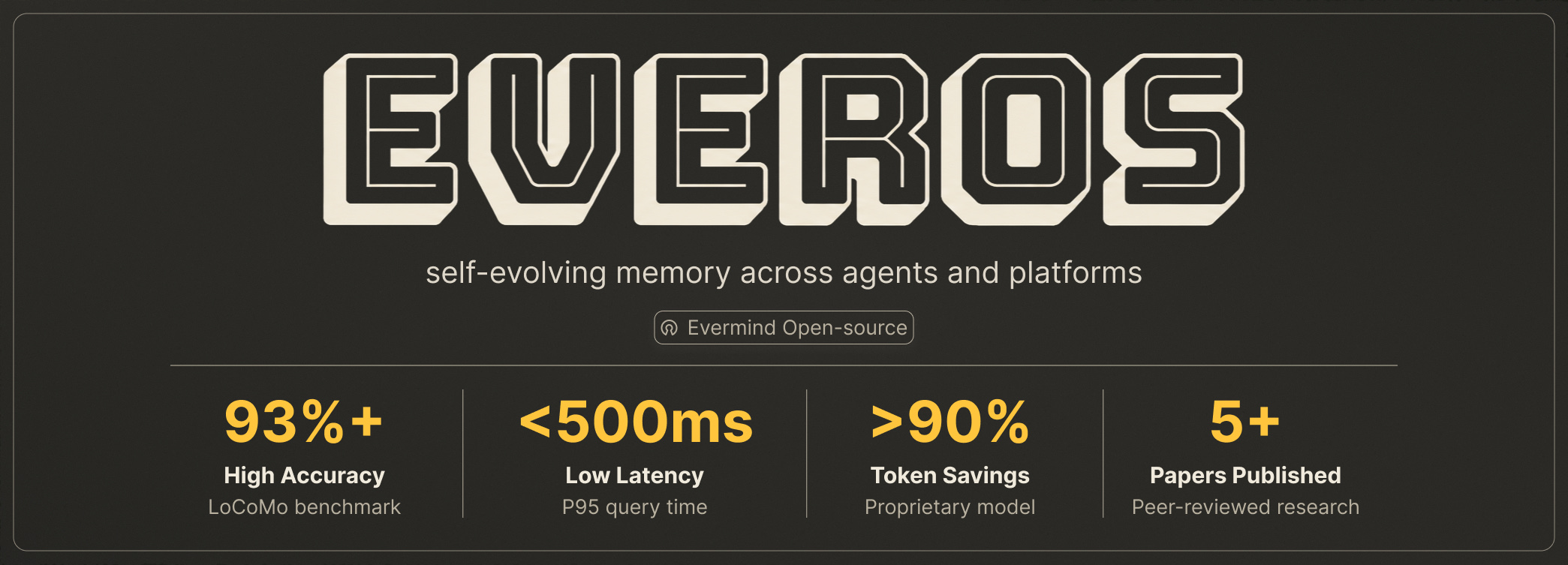
EverOS achieves 93%+ retrieval accuracy on the LoCoMo benchmark with p95 query latency under 500 ms, reducing token usage by ~90% vs loading the entire context window.
A background offline-memory-evolution (OME) scheduler runs in-process: reflection merges episode clusters and refines profiles/skills between sessions, skill distillation promotes repeated Case patterns into Skills, and a cascade file watcher keeps the derived indexes in sync whenever you edit a Markdown source file directly.
Recent Changes
initial build upstream 1.2.3